November 2025 Researcher Profiles
The Graeme Clark Institute is pleased to present our 2025 Diversity in STEM Student Award recipients for our profile feature this month!
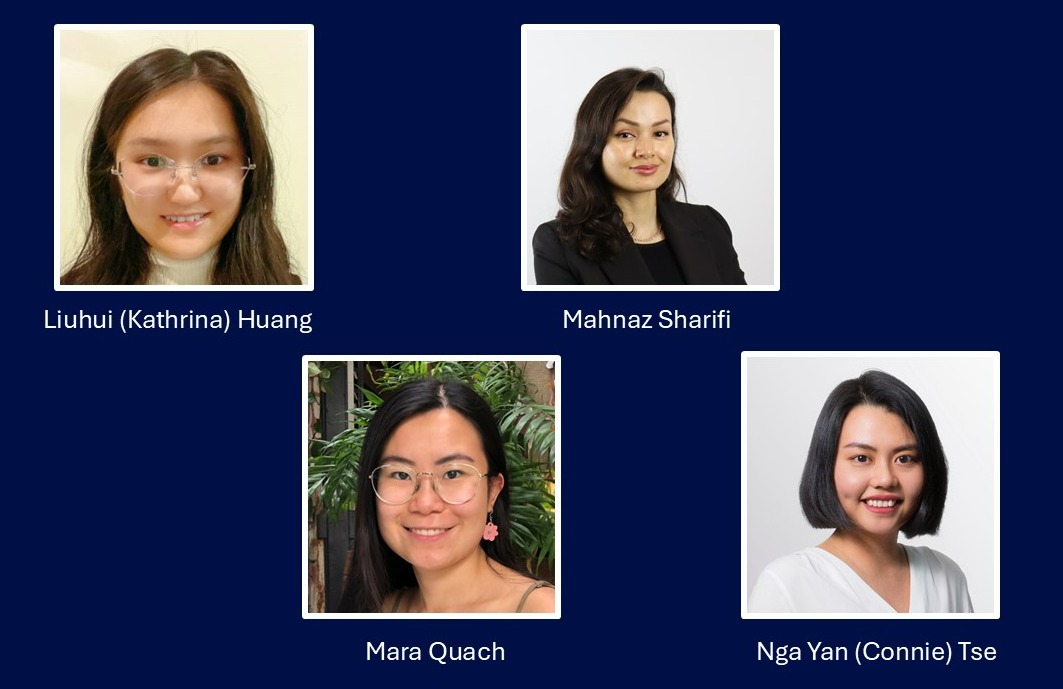
Liuhui (Kathrina) Huang (Surgery/Ophthalmology, MDHS)
Dr Liuhui (Kathrina) Huang is a licensed ophthalmologist from China and a recognised Shanghai Excellent Graduate and Outstanding Resident Physician, now undertaking her PhD at the Centre for Eye Research Australia with support from a Melbourne Research Scholarship. She has authored nine peer-reviewed papers, holds six granted patents, and leads research focused on improving ophthalmic surgical outcomes and developing innovative gene therapies for inherited retinal diseases, including novel RNA-editing approaches using a single-AAV system. She previously secured a National Natural Science Foundation of China grant to investigate gene and pathway targets in familial exudative vitreoretinopathy, earning an ARVO Travel Grant in 2025. Alongside her research, she contributes to academic leadership as President of the CERA ORBS committee, a member of the GCI Student Committee and Secretary of the SJTU Australia Alumni Association, supporting China-Australia research collaboration. Her dedication to advancing translational therapies for blinding retinal diseases has been recognized through recent honours including the GCI Women in STEM Student Award (first prize) and nomination for the Australian Academy of Science – Lindau Nobel Laureate Meeting Fellowships.
Mahnaz Sharifi (Department of Obstetrics, Gynaecology and Newborn Health, MDHS)
Mahnaz Sharifi is a third-year PhD candidate in the Department of Obstetrics, Gynaecology & Newborn Health, where she works with the Fertility Preservation Taskforce Group. Her research focuses on co-designing and evaluating an online fertility-preservation decision aid for paediatric cancer patients and their families, to improve oncofertility care for young people in Australia. She has presented her findings in both poster and oral sessions at national and international conferences. Before starting her PhD, Mahnaz trained and worked as a midwife, gaining hands-on clinical experience. She volunteered with the United Nations Population Fund (UNFPA) to support sexual and reproductive health services for Afghan refugee women in Iran. Her own journey as a refugee in Iran deeply inspires her commitment to equity in sexual and reproductive health and fuels her passion for improving access to healthcare for those who are often underserved.
Mara Quach (Department of Biomedical Engineering, FEIT)
Mara Quach is a final-year PhD student in the Department of Biomedical Engineering. Her research concentrates on Chemical Exchange Saturation Transfer (CEST) – a novel but powerful magnetic resonance imaging (MRI) method that holds promise to provide safe, non-invasive, and high-resolution in vivo imaging of biomarkers for many neurological conditions. However, symptomatic of its relatively new presence, CEST at ultra-high-field has numerous technical and practical challenges that render it incompatible with clinical use. Using the 7T MRI scanner at the Melbourne Brain Centre Imaging Unit, Mara’s work focuses on developing novel methods for CEST acquisition and analysis to make it robust for research and clinical deployment. Outside of her PhD, Mara has worked on several neuroimaging projects that contribute to research into conditions such as motor neuron disease, stuttering, and traumatic brain injury. Mara is an enthusiastic peer-to-peer leader, having served as organising members of several student-led organisations on- and off-campus.
Nga Yan (Connie) Tse (Department of Psychiatry, MDHS)
Connie is a third-year PhD candidate in the Department of Psychiatry, with formal training in clinical neuropsychology and transcranial magnetic stimulation (TMS). Her research vision centres on the optimisation of brain stimulation therapeutics, particularly TMS, in which functional neuroimaging methods are used to refine treatment targeting. This led her to focus her PhD on elucidating brain circuit alterations central to youth major depressive disorder, as well as the interplay between functional connectivity and clinical factors in shaping connectivity-guided TMS outcomes in adults with treatment-resistant depression. She recently received the Best Paper Award (student category) at the 2025 Biological Psychiatry Australia (BPA) conference as well as a travel grant for the Society of Mental Health Research (SMHR) Conference. Her abstract was also selected for oral presentation at both conferences.