October 2025 Research Profile: Dr Ellie Hajizadeh
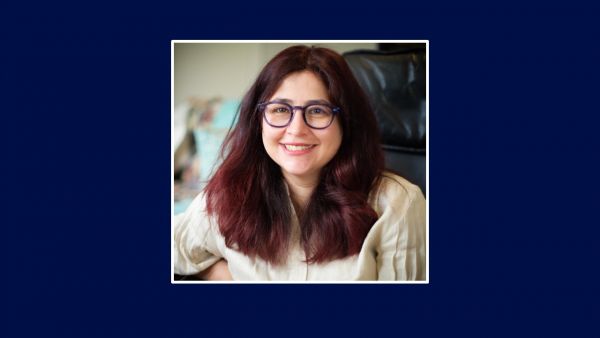
Meet Dr Ellie Hajizadeh, Head of the Soft Matter Informatics Research Group and Sub-theme Lead at the Graeme Clark Institute, who is redefining how we discover and design materials that interact with life.
Dr Ellie Hajizadeh is redefining how we discover and design materials that interact with life. As Senior Lecturer, Entrepreneur, and Head of the Soft Matter Informatics Research Group at the University of Melbourne, with a track record spanning industry, Defence, and academia, she envisions a transformative paradigm for understanding life itself - how it evolves, functions, and responds to disruption and disease across the intricate hierarchy of existence. She pioneers development of AI-powered in silico ecosystems simulating therapeutic interactions at sub-cellular and cellular levels, with a recent ARC Discovery funded project that investigates nanoengineered polypeptides to address antimicrobial resistance. Her tri-sectoral translational approach is demonstrated through her Australia's Economic Accelerator (AEA) -Ignite award, scaling up her AI-enabled material simulation software platform for next-generation dental restorative materials.
What advice would you give to students or young professionals?
In today's rapidly evolving landscape, especially with AI transforming research, agility in learning is essential, but true agility requires strong foundations. Build deep expertise in core principles, cultivate comfort with discomfort, and actively seek diverse experiences across sectors and disciplines, as these create the mental flexibility to quickly integrate new tools and approaches. Finally, invest in relationships and find what grounds you outside work; sustainable agility comes from having both broad perspectives and the resilience to navigate constant change without losing yourself in it.
Where do you see your research focus in the next 5–10 years?
I believe accelerating discovery requires integrating all four paradigms of science — theory, experimentation, computation, and data science — into a unified framework. For my work, this means combining multiscale materials simulations with robotic polymer synthesis, real-time high-throughput analysis, and ML-enabled intelligent search strategies to create a truly autonomous exploration pipeline. We're already developing this approach across multiple biomedical applications, and over the next 5-10 years, I envision scaling this integrated paradigm to fundamentally transform how we design and deploy therapeutic materials, from antimicrobials to regenerative biomaterials.
What motivates you to continue working in research despite its challenges?
I've always been drawn to the unknown — the things that challenge and even scare me — and that curiosity remains my core driver. Equally important is my commitment to giving back; I've been shaped by the people and opportunities this world has offered me, and I see my science as a way to improve people's quality of life. What's evolved over my career is finding equal joy in mentoring the next generation; there's something deeply rewarding about empowering young scientists to embrace their own curiosity and develop the courage to tackle problems that seem impossibly complex.
Who is your biggest inspiration or most influential person in your life?
My former supervisor at Defence, Dr Len Davidson, remains the most influential leader I've worked with and has fundamentally shaped my leadership philosophy. He kept a photo on his office door of submariners reuniting with their families, which he looked at daily as a reminder that his role was to support his team so we could focus on our mission, bringing submariners home safely. His compassionate, humble, and empowering leadership — especially his commitment to championing the voiceless — taught me that great leaders create the conditions for their people to become the best versions of themselves, and I strive to model that approach in my own leadership today.
What's a fun or little-known fact about yourself?
At 15, I wanted to be a film director and enrolled in a four-year program with a youth cinema institute while in high school, driven by a passion for large-scale impact on humanity's quality of life — whether through ideas that could shape societies toward social justice or through technology. I was persuaded to study engineering instead, reasoning that great directors didn't need formal training, and ultimately discovered that science offered an equally powerful path to the meaningful impact I'd always been seeking. That filmmaking experience still shapes how I articulate complex ideas and teach through storytelling to create lasting impact.
Find out more about Ellie's current research HERE.