2025 Cross-Faculty Seed Funding Scheme Winners Announcement!
The Graeme Clark Institute Cross-faculty Seed Funding Scheme is created in partnership with the Faculty of Engineering and Information Technology (FEIT), Faculty of Medicine, Dentistry and Health Sciences (MDHS), and Faculty of Science (FOS) to provide financial support to early to mid- career researchers who are employed by the University of Melbourne. The funding is for small to medium sized projects within the biomedical engineering and medtech research fields.
This year’s program was delivered in two rounds: applicants first submitted proposals in Round 1, and shortlisted candidates were then invited to deliver three-minute live pitches at our Pitch Event during Melbourne Connect Innovation Week!
The Graeme Clark Institute is pleased to announce the following winning projects of the 2025 Cross-Faculty Seed Funding Scheme!
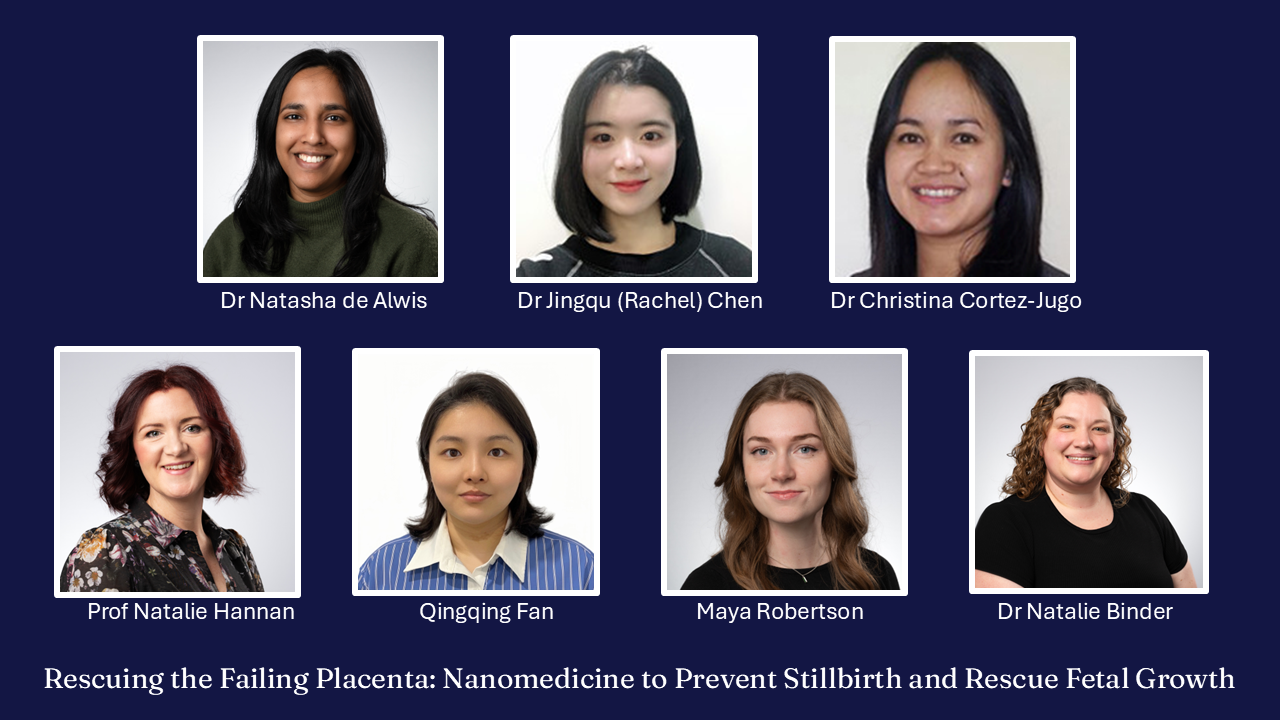
Rescuing the Failing Placenta: Nanomedicine to Prevent Stillbirth and Rescue Fetal Growth
Fetal growth restriction is a serious pregnancy complication and the leading cause of stillbirth worldwide, caused by poor placental function, low blood supply, and oxidative stress, with no current medical treatments. This project brings together expertise from MDHS and FEIT to tackle this challenge by delivering the cardiovascular drug prasugrel directly to the placenta using novel nanoparticles. Prasugrel has been shown in mouse models to improve placental blood flow, reduce oxidative stress and rescue fetal growth, but targeted delivery is needed to avoid side effects for mother and baby. Building on previous work with biocompatible metal phenolic network nanoparticles, which can carry small molecules and target specific organs, we aim to encapsulate prasugrel for safe and effective placental delivery, improving fetal growth while minimizing off-target effects.
Project Members: Dr Natasha de Alwis (MDHS), Dr Jingqu (Rachel) Chen (FEIT), Dr Christina Cortez-Jugo (FEIT), Prof Natalie Hannan (MDHS), Dr Natalie Binder (MDHS), Qingqing Fan (FEIT), Maya Robertson (MDHS)
Tailored Degradation, Targeted Growth: A Novel Approach to Bone Implant Fatigue Protection

Up to half of patients undergoing bone reconstruction surgery after tumour removal experience complications that require revision surgery, implant removal or even limb amputation. While reducing implant stiffness with lattice structures can improve bone-implant integration, it also increases the risk of implant fatigue, which has limited their clinical use. To address this, this project proposes a novel bioactive lattice filler that degrades at the rate of bone growth and releases small amounts of a growth factor to accelerate osteointegration, protecting the implant from fatigue. The filler uses a polyethylene glycol (PEG)-based hydrogel to deliver recombinant human Bone Morphogenetic Protein-2 (rhBMP-2) in a sustained-release system, promoting rapid and complete bone healing even in patients with impaired recovery due to chemotherapy or radiotherapy.
Project Members: Dr Reza Sanaei (FoS), A/Prof Charles Pagel (FoS), Dr Paul Gurr (FEIT), Prof Greg Qiao (FEIT)
Assessing real-world mobility and environmental triggers in Parkinson’s disease using a portable home-based system

Parkinson’s disease (PD) is the world’s fastest-growing brain condition and often causes walking problems such as shuffling steps, freezing and falls, especially in tricky spaces like doorways or when turning. Most research has studied these issues in labs, but little is known about how real homes affect walking. This project will use the easy-to-set-up “Senstride” system, a smartphone attached to a walking frame, to track both walking patterns and features of the home environment. This will help to understand how everyday surroundings influence mobility in PD and lay the groundwork for smarter fall-prevention tools to support people living with the condition.
Project Members: Dr Kelly Bower (MDHS), Prof Jennifer McGinley (MDHS), Dr Justin Fong (FEIT), Prof Ying Tan (FEIT), Dr Tomislav Bacek (FEIT)
For further details on the Cross-Faculty Seed Funding Scheme, please CLICK HERE.