2024 GCI Industry Collaboration Funding Scheme Winners Announcement!
This new funding scheme aims to provide financial support to GCI researchers including graduate researchers employed/enrolled at the University of Melbourne. The funding is for small to medium sized projects within the biomedical engineering and medtech research field.
The GCI is pleased to announce the below winning projects of our 2024 Industry Collaboration Funding Scheme!
Simultaneous anatomical and physiological MRI in musculoskeletal imaging:

Sodium-MRI detects changes in cartilage and muscle morphology associated with sodium homeostasis dysregulation, opening a window into physiology. It promises great potential in the diagnosis, treatment guidance and monitoring of MSK conditions, but its integration in clinical routine is hampered by hardware impracticalities.
This project will develop simultaneous anatomical and physiological (sodium) MRI and addresses coil inflexibility by using a modular coil setup and achieves high image quality through the innovative integration of dielectric pads.
Chief Investigators:
- Dr Yasmin Blunck, Biomedical Engineering, University of Melbourne
- Dr Jon Orlando Sollas Cleary, Guy's and St. Thomas's Hospitals NHS Foundation Trust
- Prof Gregor Adriany, University of Minnesota Medical School
Development of a 3D diabetic skin model for assessment of novel wound healing therapeutics

The proposed project will develop a 3D organotypic diabetic wound model using fibroblasts from 10 type II diabetes mellitus patients, to resemble the native skin tissue more accurately. This collaboration will provide a clinical perspective and connection to the patients, who have a lived experience of diabetes and the associated complications, such as diabetic foot ulcers (DFUs).
This model aims to be more representative and therefore more capable of accurately assessing novel therapies for treating DFUs.
Chief Investigators:
- Dr Rachael Moses, Faculty of Medicine, Dentistry and Health Sciences, University of Melbourne
- A/Prof Paul Wraight, The Royal Melbourne Hospital
Smart intra-arterial fluid management system for endovascular neurointerventions
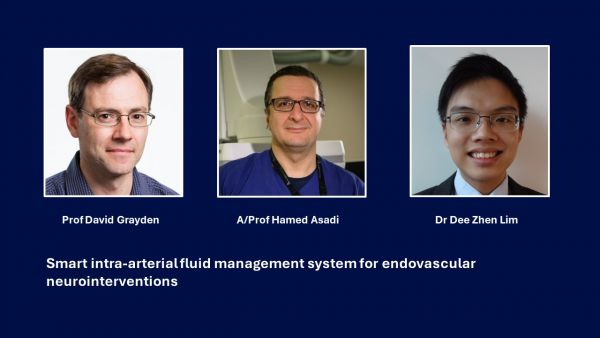
During endovascular intervention, it is important to have continuous intra-arterial fluid flush to prevent catheter clot formation, which can embolize and cause stroke. The current intra-arterial fluid system is inadequate and poses potential risks to patients. The system hinges on staff monitoring the flush drip chamber periodically to ensure an appropriate amount of fluid is infused.
This project aims to develop the world’s first smart intra-arterial fluid management system that automatically monitors real-time drip rate, fluid bag volume and pressure, and alarms when parameters are outside set thresholds.
Chief Investigators:
- Prof David Grayden, Clifford Chair of Neural Engineering, University of Melbourne
- A/Prof Hamed Asadi, Austin Health
- Dr Dee Zhen Lim, Austin Health
For further details of the GCI Industry Collaboration Funding Scheme please click here.