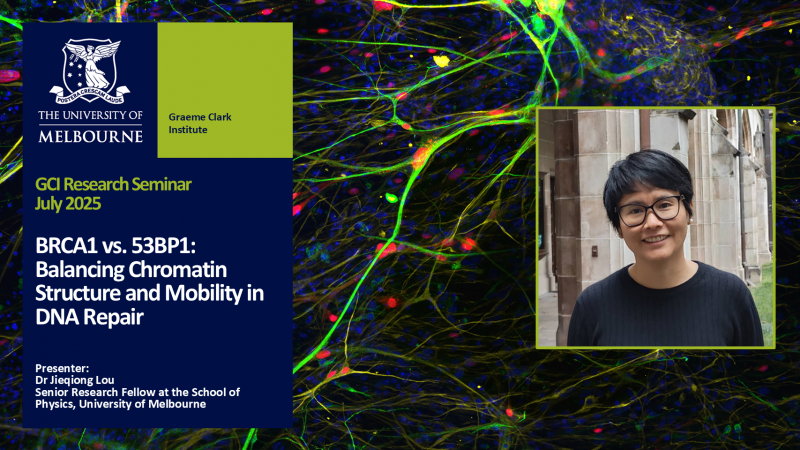
GCI Seminar Series July 2025: BRCA1 vs. 53BP1: Balancing Chromatin Structure and Mobility in DNA Repair
Share via
Presenter: Dr Jieqiong Lou, Senior Research Fellow, School of Physics, University of Melbourne
Date and Time: Wednesday 23 July, 12 - 1pm
Venue: Hybrid event
- BME Boardroom G32, 203 Bouverie St, CARLTON
- Or via ZOOM Link (Meeting ID: 845 0805 3922, Passcode: 082036)
Abstract:
DNA double-strand breaks (DSBs) are among the most lethal forms of DNA damage, repaired primarily by non-homologous end joining (NHEJ) or homologous recombination (HR). While the molecular regulation of these pathways is well characterised, the role of chromatin’s physical state in DSB repair remains poorly understood. Here, using correlative single-particle tracking and histone FLIM-FRET microscopy, we uncover a novel biophysical mechanism by which BRCA1 prevents chromatin overcompaction and slows DSB mobility, thereby promoting controlled repair. In contrast, 53BP1 promotes chromatin compaction and increases DSB mobility, acting antagonistically to BRCA1. We further show that dual depletion of BRCA1 and 53BP1 restores chromatin structure and mobility to wild-type levels. These findings explain why BRCA1-deficient cancers are sensitive to poly(ADP-ribose) polymerase (PARP) inhibitors, due to increased DSB mobility, and why loss of 53BP1 in these cancers leads to PARP inhibitor resistance by re-establishing normal chromatin dynamics. Our study reveals a previously unrecognised chromatin-based biophysical mechanism underlying PARP inhibitor response and resistance in BRCA1-deficient patients.
About the Speaker:
Dr. Jieqiong Lou is a Senior Research Fellow at the School of Physics, University of Melbourne, specialising in chromatin architecture and DNA repair using advanced fluorescence microscopy. Her recent research has significantly advanced our understanding of how dynamic chromatin reorganisation regulates DNA repair (Lou et al., 2019, PNAS; Lou et al., 2024, Nucleic Acids Research). Key contributions include uncovering the role of chromatin dynamics in the recruitment of repair proteins (Lou et al., 2020, Nature Communications), influencing DNA repair pathway choice (Lou et al., 2021, Frontiers in Genetics; Mitrensti and Lou, 2022, Molecular Cell), and modulating repair fidelity in response to drug treatment in Breast Cancer 1 (BRCA1)-deficient cancer cells (Lou et al., in preparation). Looking ahead, she aims to leverage her expertise in advanced light microscopy and DNA repair to develop imaging-based assays for predicting drug sensitivity in homologous recombination–deficient cancers.